Running a commercial warehouse or logistics hub in Erie County, from Cheektowaga’s industrial pockets to the freight corridors of South Buffalo, means your perimeter fence is your baseline security. Two challenges come with the territory: keeping out trespassers and holding up through Western New York winters. Cheap big-box store fencing warps, sags, and heaves out of alignment within a couple of seasons. Heavy-duty commercial chain link is built specifically to avoid those failures, and understanding what goes into a proper installation helps facility managers make informed decisions from the start.
Why Chain Link Fencing Works for Commercial and Industrial Sites
Industrial yard managers consistently choose chain link fencing over solid wood, vinyl, or ornamental iron for three practical reasons: sightlines, wind performance, and cost at scale.
High-security operations depend on clear lines of sight. Solid privacy walls create immediate blind spots for exterior security cameras, yard supervisors, and police patrols. The open diamond weave of commercial chain link fence eliminates that problem without requiring additional surveillance infrastructure to compensate.
Wind load is the second major factor. When autumn gales and winter blizzards sweep off Lake Erie, a solid privacy fence acts like a sail; enough sustained force can snap posts or twist an entire fence line out of alignment. Chain link fencing allows wind to pass directly through the structure without building pressure against the posts or framework, preserving alignment through even the worst Western New York weather.
Cost efficiency at scale is the third consideration. On multi-acre industrial yards along the Buffalo River waterfront or in the freight corridors of Cheektowaga, commercial chain link delivers strong perimeter security at a lower material cost per linear foot than any comparable barrier. That difference is significant when you’re fencing hundreds or thousands of feet of property line.
Key Features of Heavy-Duty Chain Link: Gauge, Coating, and Framework
Commercial chain link fence installation involves more than driving posts and stretching wire. The materials selected determine how long that fence holds up against industrial activity, attempted intrusions, and the particular demands of Erie County’s climate. Three build specifications matter most.
1. Wire Gauge
Wire gauge directly dictates the raw toughness of your mesh.
- 11-Gauge: Standard residential weight. It’s too weak for industrial yards and clips open easily with basic hand tools.
- 9-Gauge: The proven industry baseline for heavy-duty commercial chain link fence. It’s thick, rigid, and stands up to hard impacts.
- 6-Gauge: Ultra-heavy steel wire built for high-security sites, critical infrastructure, and yards holding high-value freight.
Getting the gauge right from day one saves you from expensive rebuilds later. A perimeter that buckles during the first break-in attempt isn’t protecting your bottom line.
2. Protective Coatings
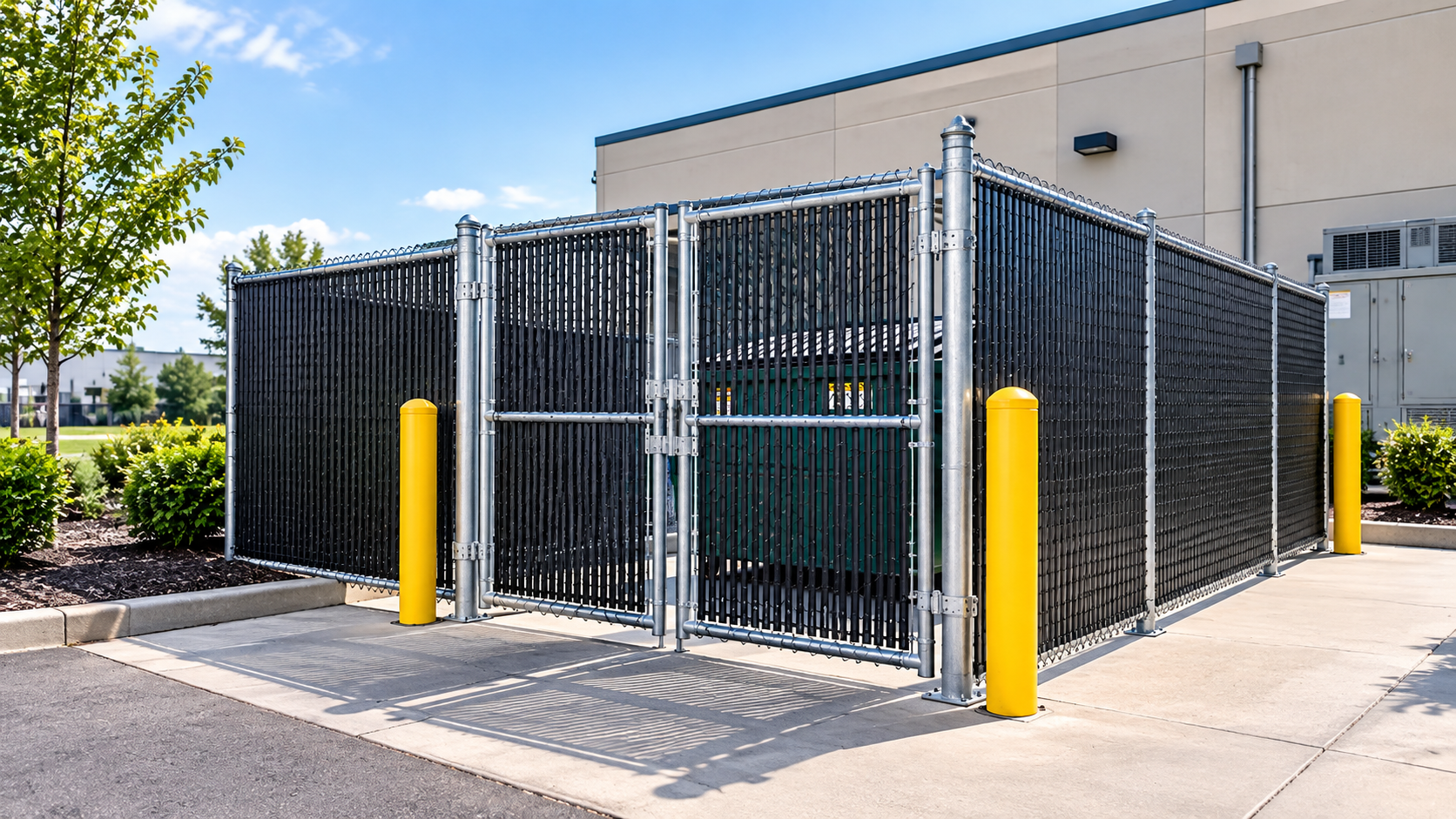
Raw steel rots out fast in Western New York. Muggy summers, heavy winter road salt, and brutal freeze-thaw cycles constantly attack bare metal. Hot-dip galvanization dunks the steel in molten zinc, locking out moisture and stopping rust before it starts. For yards needing extra protection or a cleaner commercial look, we use a fused PVC or polymer coating over the galvanized wire. This heavy outer skin shields your fence from chemical spills, salt spray, and scrapes from forklifts or trucks working against the property line.
3. Framework Specifications
The wire mesh is only as strong as the steel framework holding it. Genuine industrial chain link fence installations require Schedule 40 steel pipe for all terminal, corner, and line posts. Thin-walled residential tubing is a common cost-cutting substitution; it buckles under heavy snow loads, deflects when struck by equipment, and fails under a climber’s weight far sooner than Schedule 40 pipe. Local Buffalo codes typically require a site review for fence heights over 8 feet, and setback requirements should be verified before any materials are ordered.
Installation: What Keeps It Standing Through Western New York Winters
Correct material selection only solves part of the problem. A commercial chain link fence built from the right components will still fail if the installation cuts corners on depth and foundation work.
Erie County clay holds high moisture content. When that moisture freezes during winter, it expands upward with significant force, a process called frost heave. Post footings set too shallow get pushed out of the ground over successive freeze-thaw cycles, leaving posts leaning and wire fabric sagging. That kind of failure doesn’t announce itself immediately; it develops gradually and often goes unnoticed until the fence line has shifted noticeably out of alignment.
To prevent frost heave, installation crews must set all terminal and line posts below the regional frost line, reaching a minimum depth of 36 to 42 inches. Concrete footings should be poured as straight-sided cylinders rather than tapered cone shapes, which offer less resistance to upward heaving forces. Once the foundations have cured, 9-gauge fabric is mechanically tensioned using heavy industrial winches and secured with heavy-duty tie wires, keeping the mesh rigid and taut over years of service.
Height, Mesh Size, and Security Configuration
Fence height and mesh opening size are both security decisions, not just material choices. For industrial fencing applications, 8 feet is the standard baseline height. That dimension keeps the fence difficult to scale without equipment and provides the clearance needed to mount three-strand barbed wire outriggers along the top rail.
The standard diamond opening size for commercial chain link applications is 2 inches, which provides solid general security for most warehouse and distribution environments. Facilities storing high-target assets, copper pipe, catalytic converters, heavy machinery, or high-value fleet vehicles, should consider heavy mini-mesh. Mini-mesh tightens the diamond openings to an inch or less, eliminating fingerholds for climbing and preventing standard bolt cutters from getting a clean angle on the wire. It’s a meaningful upgrade for any yard where theft is an ongoing concern.
Site Conditions and Their Impact on Timeline and Cost
Ground conditions determine the pace and complexity of any commercial fence installation. A flat, open yard with clear access allows crews to work efficiently with heavy machinery, driving posts at consistent intervals and stretching long, uninterrupted runs of wire fabric. Cramped urban properties, older industrial waterfront lots with buried infrastructure, or sites adjacent to active loading docks require more site preparation and more careful maneuvering around existing operations.
Erie County clay and potential bedrock layers both affect equipment selection and time on site. Large-scale properties, those covering several acres with irregular boundaries, require strategic placement of gate systems and intermediate terminal posts to maintain proper tension across the full fence line. Poorly planned terminal post placement on a long run results in sagging fabric that’s difficult to correct without re-tensioning the entire section.
When evaluating commercial chain link contractors, ask whether they own their post-driving and core-drilling equipment. Contractors relying on rented machinery introduce scheduling uncertainty. Delays in equipment availability extend project timelines and can push installations into weather windows that complicate concrete curing.
FAQs
How long does a commercial chain link fence last in Buffalo?
A heavy-duty chain link fence built with hot-dip galvanized 9-gauge wire and Schedule 40 pipe framework will typically last 20 to 30 years under normal industrial conditions. Post depth and foundation quality are the primary factors in long-term durability.
What separates commercial from residential chain link?
Commercial chain link fencing uses heavier wire fabric, 9-gauge or 6-gauge, versus residential 11-gauge, and thick-walled Schedule 40 steel pipe. That combination handles industrial impacts, sustained climbing attempts, and high seasonal wind loads without deforming or shifting out of alignment.
Can privacy slats be added to an existing fence?
Yes. Privacy slats can be retrofitted into commercial chain link at any point after installation. Because slats significantly increase wind resistance by turning an open mesh into something closer to a solid wall, the original framework needs to be engineered with heavier posts to handle that load safely. Retrofitting slats onto a framework not built for the wind load creates the risk of post failure.
Do commercial fence installations in Erie County require permits?
Yes. Permit requirements vary by municipality, zoning classification, fence height, and intended use. Local ordinances govern setback distances from property lines, maximum allowable heights, and the use of barbed wire or security outriggers based on industrial zoning designations. Confirming requirements before ordering materials avoids costly adjustments mid-project.
Are there restrictions on barbed wire use?
Most municipal building codes only permit barbed wire on fences at least 6 feet high, with 8 feet being the standard for commercial fencing applications. That minimum height keeps barbed strands well above accidental contact for anyone passing near the fence line.
How are posts installed over concrete?
For reinforced concrete pads, crews use core-drilling equipment to cut precise holes through the slab. Posts are set into the underlying subbase and anchored with high-strength concrete, producing a secure foundation without compromising the existing pad.
Why does contractor selection matter?
Cut-rate installers use thin tubing, shallow footings, and poor tensioning to cut costs. Within two Buffalo winters, this causes sagging wire and leaning posts. Hiring an experienced commercial contractor with the right heavy equipment is the only way to ensure a lasting perimeter.
Secure Your Facility with All Pro Fence?
All Pro Fence Buffalo installs commercial chain link fence systems for warehouses, distribution centers, and industrial properties throughout Western New York. Call All Pro Fence Buffalo today.